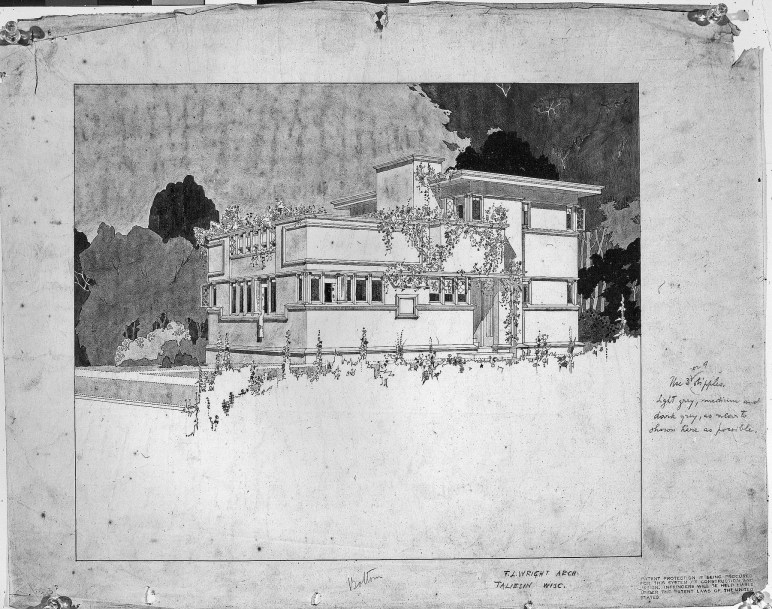
Let’s stop blaming WWI and credit Frank Lloyd Wright for preventing the theft of his American System-Built Homes
As Frank Lloyd Wright was preparing to sue Arthur Richards and the Richards Companies to end their partnership to sell and supply American System-Built Homes (ASBHs), Wright wrote to his lawyer Emerson Ela, saying:
“Richards – as might be expected – has complied only to make a bluff at it.
The following is lacking and he retains copies of everything he returns of course. We should insist on the total disappearance from his office or his agents of all copies of plans or any advertising matter.“
… and then Wright listed drawings and files that he believed Richards was holding, including some that Wright was sure that Richards planned to build without him.
Wright’s accusation was clear and emphatic: A theft was underway and Ela would need evidence to compel the court to stop it. Case evidence, Wright predicted correctly, would be found in model numbers, methods and designs that Wright had created, but that Richards was preparing to take, modify and sell without him. Richards had been asked to return Wright’s work and hadn’t done it. Ela needed to convince the court to demand its return.
It is commonly reported that the ASBH project ended due to World War I. This is a misreading of the physical evidence. Indeed, when Wright won the lawsuit, the court ordered that Richards return every project document to Wright.
Within these documents are a series of Wright’s designs containing Richard’s handwritten mark-ups to instruct Russell Williamson, then employed by Wright as the ASBH draftsman, to exclude Wright on future copies.
In pencil, Richards directed Williamson to remove Wright’s name and moniker by crossing them out and then writing the word “off” (this would later be erased, albeit poorly). He also highlighted elements to include, like the ASBH part number and name. There are a handful of examples of this activity in the archive. For example, Wright’s design for the model ASBH J-900 can be seen on JSTOR and features Richard’s edits:
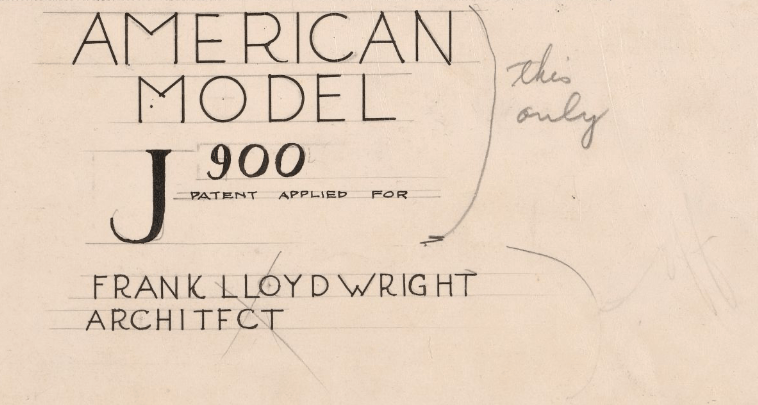
The archives also reveal that Williamson followed Richards’ directions exactly on new versions. Clean, new drawings naming no architect would allow Richards to continue selling ASBHs without credit or commission. Richards planned to “rebrand” ASBHs and was, at the time, calling them “American Homes”. He also planned to employ Williamson in the work, when Wright was out of the mix.
But Wright and the court stepped in to stop them.
When Ela won on behalf of Wright in Dane County Circuit Court in February of 1918, Wright had prevented his former colleagues from selling and supplying ASBHs without him. The court ruled that Wright was the sole owner of all ASBH designs and the methods to build the homes, but the ruling was double-edged. While Wright retained all of his intellectual property, the capacity to sell and build was gone; so he would stash the evidence and never speak of the homes or the men again.
WWI would provide a useful smokescreen to hide the underlying drama. Wright wanted to erase the partnership from history. Best to go silent and lock the file cabinet.
If you would like to see this story unfold visually (and study more of the evidence on a bigger screen), consider attending an upcoming talk. Watch here for dates and times.
– Nicholas Hayes, 2026
The featured image above is used with permission1 and features handwritten notes by both Frank Lloyd Wright and Arthur Richards. I expect Wright also stamped this drawing to warn “infringers” of looming patent protection when the drawing was returned to him for safekeeping by court order.
- Frank Lloyd Wright Foundation Archives: architectural drawings, ca. 1885–1959. The Frank Lloyd Wright Foundation Archives (The Museum of Modern Art | Avery Architectural & Fine Arts Library, Columbia University, New York). ↩︎


Excellent, thanks.
I am a step-on guide for the Road Scholar tours that go to the Burnham Block. I have done 25 of them, with two more to go this year. I always mention Richards’s chicanery as well as wartime material shortages as being the end for ASB.
All the best,
Mark
>
Thanks for all you do, Mark. I hope the “shortage” story goes away soon. It’s convenient, but the evidence, including the Bellews’ and Beverly houses, say otherwise. It was always only “cover” to protect reputation. Take good care. -N