We called a remodeling contractor friend and told him we’d purchased a Frank Lloyd Wright house, and he asked “… should I congratulate or scold you?”
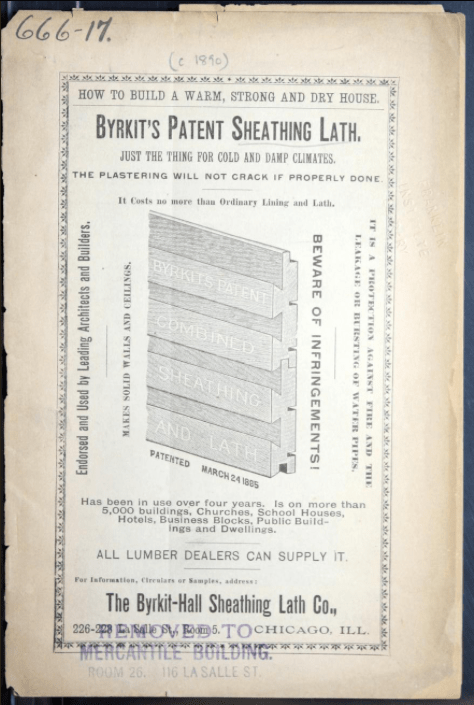
Our experience, so far, belies the popular myth that Wright homes are leaky and cold. This little house is (knock on wood) dry and without a draft. Credit, we think, goes to the use of Byrkit Lath to sheathe both the interior and exterior walls and ceilings.
Patented and marketed starting in 1890, Byrkit was pitched as a stronger, longer lasting, easier to install substrate on which to apply plaster.

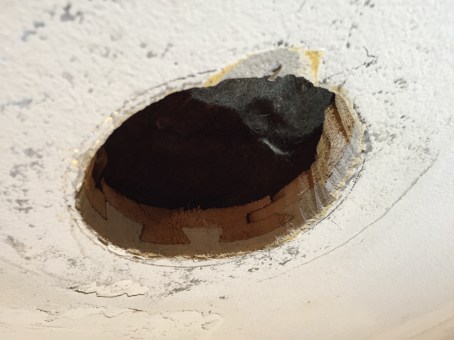
It’s an ingenious idea: tongue and grooved boards are milled with trapezoidal slots into which wet plaster is pressed, locking the system together, setting and sealing it as it dries. The result is a waterproof wall with incredible strength that is relatively lightweight.
A modern metaphor is the use of closed-cell foam core materials covered in carbon-fibers impregnated with epoxy in boats, cars and rockets. The hollowness creates lightness. Interlocking fibers create strength. The uniform thin-walled surfaces create stiffness and structural integrity.
By specifying Byrkit Lath in this and other American System-Built Houses, Frank Lloyd Wright may have secured this home’s legacy. In addition to creating a dry, strong and warm space that stands straight and true to this day, he may also have dissuaded major renovation. To drill a hole for a code-required exhaust vent in our new WC required a $26 masonry bit and a $26 diamond saw.

References: Mike Lilek, 2015, “2106 Newton Avenue Shorewood, Wisconsin, An American System-Built House Model A203, Frank Lloyd Wright, Architect”
 The Elizabeth Murphy House
This is a fascinating article that challenges the common perception of Frank Lloyd Wright houses being drafty and cold. Your personal experience living in one and the explanation of Byrkit Lath is a great counterpoint to that misconception.
Byrkit Lath sounds like a very interesting building material. I’m curious to learn more about it. Are there any specific advantages of Byrkit Lath besides waterproofing and creating a strong wall system?
I find it fascinating how Byrkit Lath contributed to the durability and structural integrity of this house.